

Description
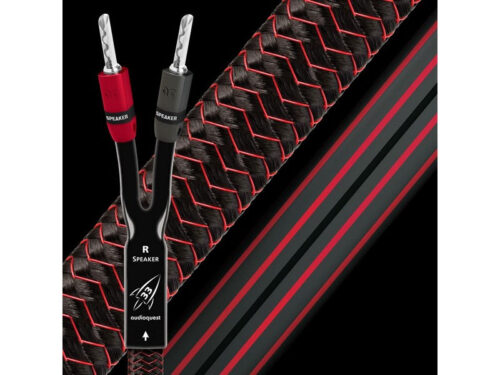
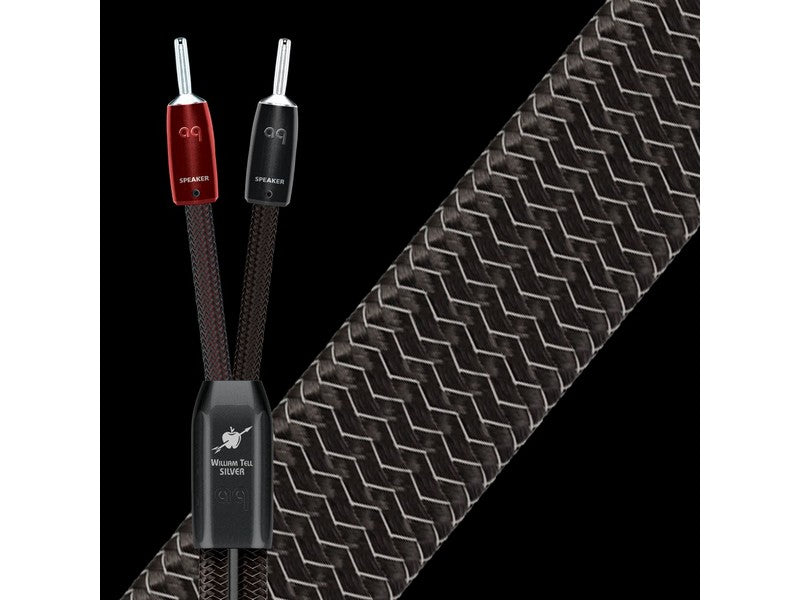
AudioQuest William Tell SILVER Speaker Cable
Building on a solid base of tried and true AudioQuest technologies, the design team of Garth Powell and Bill Low specifically focused on addressing one of the most vexing issues plaguing speaker cable design: the mismatch between the amplifier’s source impedance and the speaker’s load impedance. By eliminating the speaker cable’s characteristic impedance (ZERO Technology), current compression and distortion of the signal/current transient are significantly reduced. The result is dynamic contrast, transient response, and bass slam that are rendered seemingly without effort, because the cable is not electrically impeding the music.
Like the larger-gauge cables of the Mythical Creatures Series, William Tell and Robin Hood can be used in one of two ways: either employing the ZERO model for Full-Range, or by using the ZERO model in combination with a dedicated BASS cable, as a fully optimized BiWire Combination cable. Like their larger siblings, William Tell and Robin Hood also feature our patented common-mode noise-rejection technology. Along with the Mythical Creatures, these latest AudioQuest speaker cables significantly outperform previous technology at controlling and draining radio-frequency noise.
Solid conductors prevent electrical strand-to-strand interaction, major sources of distortion. Surface quality is critical because a conductor can be considered as a rail-guide for both the fields within a conductor, and for the magnetic fields that extend outside the conductor. The astonishingly smooth and pure Perfect-Surface Copper+ eliminates harshness and greatly increases clarity compared to OFHC, OCC, 8N and other premium coppers. Extremely high-purity Perfect-Surface Silver further minimizes distortion caused by grain boundaries, which exist within any metal conductor.
RF/ND-TECH (PATENTED RADIO-FREQUENCY GROUND-NOISE DISSIPATION) MINIMIZES CIRCUIT MISBEHAVIOR BY CANCELLING INDUCED RF NOISE
Though a cable’s ground leads are integral to a component’s signal transmission, they also act as an antenna. Thus, they are subject to induced Radio-Frequency (RF) noise. RF noise is a parasitic signal that is typically coupled directly into a system’s most sensitive audio/video circuits. AudioQuest’s RF-on-ground Noise-Dissipation (RF/ND-Tech) greatly reduces resulting distortion and signal masking, yielding unprecedented levels of Noise-Dissipation across the widest bandwidth (range) of radio frequencies possible. Our unique circuit topology uses a common-mode phase-cancelling array, providing linear noise dissipation across the entire length of the cable.
72v Dielectric-Bias System (DBS)
Insulation is also a dielectric that can act like a shunt-filter. Biasing minimizes dielectric-noise and linearizes the filter, significantly improving wide-bandwidth dissipation of induced RF noise.
ZERO-TECH (NO DEFINED CHARACTERISTIC-IMPEDANCE) FOR UNCOMPRESSED CURRENT TRANSFER AND LINEAR NOISE-DISSIPATION
The only complete way to eliminate characteristic-impedance mismatches between a cable and the attached source and load is for the cable not to have any fixed characteristic-impedance value. ZERO-Tech accomplishes this by eliminating interaction between the insulation (dielectric) and the cable’s conductors—enabling uncompressed current transfer. All-important transient current is unrestricted, and RF Noise-Dissipation is linearized (consistent octave to octave).
DIRECTIONALITY
All drawn metal strands or conductors have a non-symmetrical, and therefore directional, grain structure. AudioQuest controls the resulting RF impedance variation so that noise is drained away from where it will cause distortion. The correct direction is determined by listening to every batch of metal conductors used in every AudioQuest audio cable.
WILLIAM TELL BI-WIRING
When possible, running separate cables to the treble and bass “halves” of a speaker significantly reduces distortion. Bi-Wiring keeps the large magnetic fields associated with bass energy out of the treble cable, allowing the delicate upper frequencies to travel a less magnetically disturbed path, like taking the waves out of the water when you swim. AudioQuest’s RF/ND-Tech (patented RF-Canceling Ground-Noise Dissipation) attracts RF energy away from the amplifier’s output. When properly implemented, Bi-Wiring has always been a cost-effective way to get better performance for the same or less money.
CARBON-BASED LINEARIZED NOISE-DISSIPATION SYSTEM (NDS)
Today’s environment is saturated with radio-frequency noise that is extremely difficult to filter or reject. The frequencies of this noise from satellites, cellular towers, and Bluetooth, etc., are so extremely narrow that a conventional shield, or a series or shunt filter, is wholly inadequate. Much of the low-level signal that carries the harmonics and spatial cues that define high-resolution audio is masked by induced radio-frequency noise.
FOLK HERO COLD-WELDED TERMINATIONS
Folk Hero cables are Cold-Welded to AudioQuest’s extremely pure Red Copper Spades or Bananas. The bare copper is submerged (hung) in a vat of pure silver instead of being tumbled in a lower-grade solution. AudioQuest speaker breakouts and plug casings are not metal in order not to induce RF Noise into the conductors.